Definition
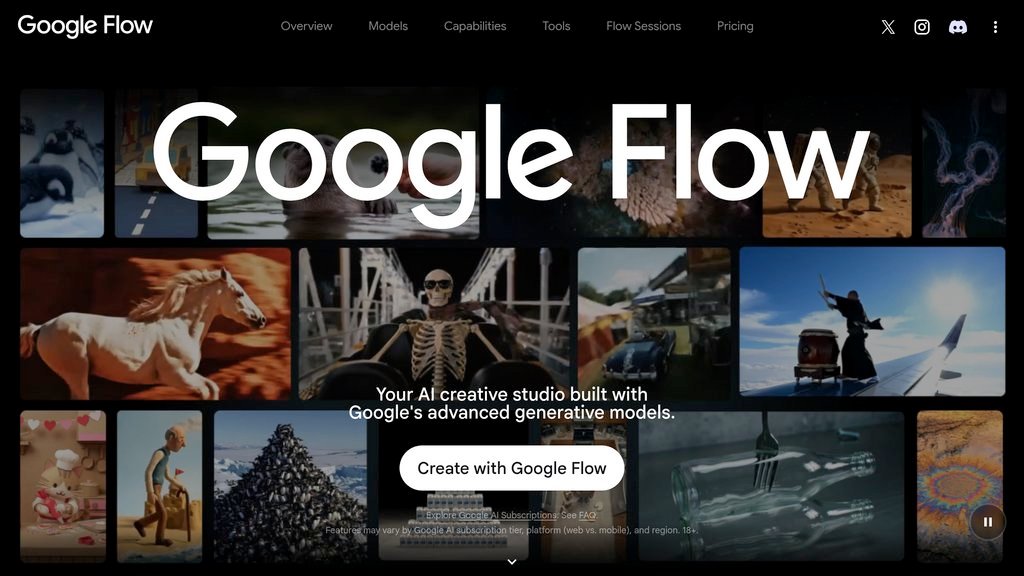
Google Flow is an AI-powered filmmaking and creative storytelling tool from Google that helps users create cinematic videos and scenes using natural-language prompts, images, and AI-generated content.
Detailed Explanation
Google Flow is designed to make AI-assisted video creation easier. Instead of manually creating every visual element, a user can describe what they want, and AI can help generate and arrange scenes.
It can be useful for:
- Creating cinematic video scenes
- Generating characters and environments
- Turning ideas or descriptions into visual content
- Maintaining consistency between scenes
- Experimenting with camera movements and visual styles
- Creating short films, advertisements, story sequences, and creative videos
For example, imagine you want to create a scene:
“A young explorer walks through an ancient jungle temple at sunset.”
Instead of creating the background, character, lighting, camera movement, and animation separately, an AI filmmaking workflow can help generate these elements from your description.
Simple Example
You could start with:
Prompt:
“A futuristic city at night, with flying cars moving between skyscrapers, cinematic lighting.”
The AI can help create the visual scene and allow you to develop it into a larger sequence.
Key Takeaway
Google Flow = AI-assisted filmmaking and cinematic storytelling.
2. Gemini
Definition
Gemini is Google’s family of multimodal AI models that can understand and generate different types of information, including text, images, audio, video, and code.
Detailed Explanation
Gemini is more than a traditional text-based chatbot. It is designed to work with multiple forms of information, which is called multimodal AI.
For example, Gemini can work with:
- 📝 Text
- 🖼️ Images
- 🎵 Audio
- 🎥 Video
- 💻 Code
- 📄 Documents
Suppose you upload a picture of a mathematical problem. Instead of only reading text, Gemini can analyze the image and explain how to solve the problem.
Similarly, you could provide:
Video + question
“Summarize the important events in this video.”
The model can analyze the video content and provide an answer.
Example
A teacher could give Gemini:
Input:
- A PDF textbook
- A diagram
- A question
Gemini could then explain the diagram and create questions based on the textbook.
Key Takeaway
Gemini = Google’s multimodal AI model family.
Note: If by “Gemini Omni” you mean a specific Google product/model named “Gemini Omni,” tell me where you encountered the term, because Google uses several Gemini model/product names and “Omni” can refer to different concepts. I don’t want to give you an incorrect definition.
3. LangChain
Definition
LangChain is a software framework for building applications powered by large language models (LLMs), especially applications that need to connect AI models with external data, tools, APIs, and workflows.
Detailed Explanation
An LLM by itself mainly receives an input and produces an output.
For example:
User → LLM → AnswerBut real-world AI applications often need much more.
For example, suppose you want to build an AI customer-support assistant.
The assistant may need to:
- Understand the user’s question
- Search the company’s documents
- Retrieve relevant information
- Call an external API
- Perform calculations
- Generate the final answer
LangChain provides components that help developers connect these different pieces.
A simplified architecture is:
User
  ↓
LangChain Application
  ↓
LLM
  ↓
Tools / APIs / Documents / Databases
  ↓
Final Answer
What can LangChain connect?
LangChain can be used to connect an AI model with:
- Databases
- APIs
- Search systems
- Documents
- Vector databases
- Python functions
- External tools
- Memory/context
- Other software systems
Example
Imagine you build a college information chatbot.
A student asks:
“What is the last date for submitting the project?”
The chatbot can use LangChain to:
Question
   ↓
Search college documents
   ↓
Find relevant information
   ↓
Send information to LLM
   ↓
Generate answer
Instead of asking the LLM to guess the answer, the application retrieves the actual college document.
Key Takeaway
LangChain = Framework for connecting LLMs with data, tools, APIs, and application logic.